Monday, September 7, 2009

Report: Roger Clemens' suit vs. Brian McNamee dismissed in Houston

A federal judge has dismissed Roger Clemens' defamation suit against his former trainer, Brian McNamee, ending that chapter of the litigation in Texas and shifting the focus to New York, where McNamee has filed his own defamation suit against the former Cy Young Award winner.

Roger Clemens suit vs. Brian McNamee dismissed in Houston

Clemens

The New York Daily News first reported the dismissal, which took place Aug. 28.

Clemens' attorney, Rusty Hardin, filed the suit on Jan. 6, 2008, in Houston, claiming McNamee was "malicious and grossly negligent" in his remarks about Clemens to baseball investigator George Mitchell and SI.com.

Federal judge Keith Ellison of the U.S. District Court dismissed the case with prejudice, meaning Clemens cannot file the suit again. Clemens does, however, retain the right to appeal.

"Brian has defeated Clemens in Texas," McNamee's lawyer, Richard Emery of the Manhattan firm of Celli, Emery, Brinckerhoff & Abady, told the Daily News. "And now the battleground moves to New York."

Clemens is under investigation by a federal grand jury in Washington that is trying to determine whether he lied when he told a congressional committee in February 2008 that he had not used steroids.

McNamee has told federal agents, Mitchell and a House committee that he injected Clemens more than a dozen times with steroids and human growth hormone from 1998 to 2001. Clemens has denied using performance-enhancing drugs.

Ellison previously had dismissed much of Clemens' lawsuit in February 2009, saying the Southern District in Houston did not have jurisdiction, and McNamee's conversations with Mitchell were protected by his immunity deal with the government.

In late June, Clemens' legal team sought to revive some of the claims in the defamation suit against McNamee, but Ellison affirmed his February ruling.

In late July, McNamee sued Clemens in federal court in Brooklyn, alleging the pitcher "waged a defamatory public relations campaign against McNamee ... intended to deceive the public and Congress into falsely believing that McNamee is a liar."

The lawsuit quotes Clemens saying in a YouTube video in 2007 that McNamee "did not inject steroids into my body either when I played in Toronto for the Blue Jays or the New York Yankees."

It also cites an interview with ESPN in May in which Clemens, when asked about McNamee, responded that it was a case of "somebody out there that is really crawling up your back to make a buck."

The suit, which seeks unspecified damages, claims Clemens' statements have "humiliated McNamee, destroyed his reputation, both personally and professionally, and caused him severe emotional distress."

Figo not planning returnDavid Ortiz of Boston Red Sox apologizes, says he never used or bought steroids

Hitting is an art form for Seattle Mariners outfielder Ichiro Suzuki

Nine years after crossing the Pacific Ocean to become the first Japanese position player in the major leagues, Ichiro Suzuki recently faced his most daunting challenge yet in America, one that pretty much defeated him: sitting on the bench.

Ichiro missed eight games at the beginning of the season when he was on the disabled list, but at least most of that stretch was spent rehabbing in extended spring training games. More recently, he spent eight games on the bench due to a sore calf muscle. Well, he spent part of the time on the bench. He also spent it in the batting cage, in the clubhouse, in the trainers' room -- anywhere to kill the time until he was able to play again.

"The thing I learned from this experience is that I would much rather play in a game where I don't get any hits or play in a game where I make an error than not play,'' Ichiro said through the Mariners' interpreter last week. "Having to go through that is a lot better than not playing in the game.''

In other words, he is not looking forward to a designated hitter role anytime soon.

[+] Enlarge
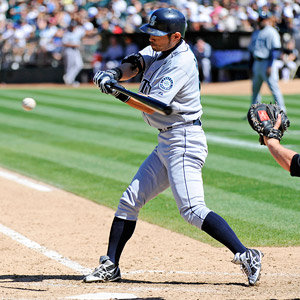
Hitting is an art form for Seattle Mariners outfielder Ichiro Suzuki

Bob Stanton/Icon SMIIchiro is the second fastest player in major league history to reach 2,000 hits.

"I think one of the requirements for being a DH is weighing at least 200 pounds, so maybe if I was that heavy I would do it,'' he said. "[But] the day I weigh 200 pounds is the day I'm inside a coffin.''

Sitting on the bench is one of the few things Ichiro has failed to do well. As his ninth season enters its final weeks, he has played in nine All-Star Games; broken an 84-year-old hits record; won two batting titles (a third is possible this year), eight Gold Gloves and an MVP; and had eight .300 seasons (with a ninth on the way). With a double Sunday, he became the first player to reach the 2,000-hit mark in less than 10 seasons. Despite missing as many games this season as the previous eight seasons combined, he needs just five more hits for his ninth consecutive 200-hit season.

He also has been refreshing proof that in an age in which so many players resemble Macy's Thanksgiving Day Parade balloons, you don't have to hit the ball into the upper deck to provide excitement. For that matter, you don't even have to hit it out of the infield.

Of Ichiro's 2,000 hits, 452 are infield singles, the most since 2001 (Juan Pierre is second with 390). The way he places the ball, his first infield double is only a matter of time. Eventually, he's going to hit a high chopper off the plate that bounces over the charging third baseman's head, squirts past the stumbling pitcher and rolls to a slow stop in front of the frustrated shortstop while Ichiro slides into second base with a double. Or maybe into third base with a triple. Or perhaps all the way around the bases for an inside-the-infield home run. You can't rule anything out with Ichiro.

The ground ball is Ichiro's art form, and the infield is his canvas.

Other players hit a ground ball, and fans groan, shake their heads in disgust and go back to the important matter of texting friends ("Justin Morneau just grounded out, and I'm going to get a beer''). Ichiro hits a grounder, and fans sit up and lean forward expectantly. This is when the fun begins.

"He's sort of specialized his approach to hitting,'' Mariners pitcher Ryan Rowland-Smith said. "He's running out of the box as soon as he makes contact. It's not like those guys who try to hit the crap out of it, and they hit a ground ball instead and then take it easy out of the box. He's two steps out of the box as soon as he makes contact.''

Two steps out of the box? Ichiro is halfway to first when the pitcher is still pulling on his stirrup socks before the game. He reaches first base faster than Derek Jeter on a date.

"I still remember the look and reaction of Jeter the first time Ichiro played against the Yankees,'' Seattle broadcaster Rick Rizzs said. "Ichiro hit a routine ball to Jeter. He got it, didn't waste any time, fired, and the throw to first base barely beat him. I saw Jeter go like, 'Wow, who is this guy?'''

Ken Griffey Jr. recently told manager Don Wakamatsu that if he had Ichiro's tools, he would have hit .450 with 750 home runs. Asked about a typical Ichiro infield single last week, Griffey said, "That's what I'm talking about. Right there, I'd be at .650. I mean, if you put those infield hits on top of anybody else's average, what's going to happen?''

“

All you just have to watch him in [batting practice] to see how far he can hit the ball. But he doesn't get outside of himself during the game, which is a compliment to the discipline he has to stay in his approach and do what he wants to do.

”-- Mariners teammate Bill Hall about Ichiro

And to think, we once weren't sure whether a Japanese player could hit in our leagues. Remember that? And now, nine years later, he has 2,000 hits and is nearing his ninth consecutive 200-hit season. The only other player with eight consecutive was Wee Willie Keeler, who did it from 1894 to 1901, when hitting them where they ain't was easier, as Stephen J. Gould suggested, because the fielders didn't know where to be.

"He understands he's a leadoff hitter and his job is to get the bat on the ball and get on base for the people behind him because he can use his speed on the basepaths,'' new Mariner Bill Hall said after watching Ichiro up close for a few weeks. "Obviously, he can hit the ball out of the ballpark whenever he wants. All you just have to watch him in [batting practice] to see how far he can hit the ball. But he doesn't get outside of himself during the game, which is a compliment to the discipline he has to stay in his approach and do what he wants to do. Yeah, he can probably hit 30 to 40 home runs if he wanted to, but he might strike out a little more and his average would drop a little more.''

The obvious question, if Ichiro truly could hit 30 to 40 home runs a season, is why he doesn't do it. Another 20 to 30 home runs a season would seem worth a drop in average or a rise in strikeouts, especially for a team that scores as seldomly as the Mariners. But it's also a pointless question, because after nine seasons, it's clear Ichiro is not going to change an approach that has worked so well for him that a career that began in Japan likely will end in Cooperstown.

Ichiro turns 36 in October, but he shows few signs of slowing down. With 54 infield hits this season, he likely will finish with the second largest total of his career (63 is his high, in 2001). Religious about keeping himself in shape, he remains as trim as the day he put on the Mariners' uniform his rookie year. Who knows what the future holds, but it isn't at all unreasonable to think he could reach 3,000 hits in the majors, which would give him 4,278 between here and Japan (more than Pete Rose's 4,256).

"I'm not a fortune teller, so I don't have the ability to look into the future,'' he told reporters Sunday about the possibility of 3,000 hits. "But that's why it's fun, because the future is unknown.''

Jonathan Papelbon of Boston Red Sox fined $5,000 for taking too long to pitchBlues continue Michel talks

Sunday, September 6, 2009

Kansas City Royals' Jose Guillen shutting it down for the season

KANSAS CITY, Mo. -- Royals outfielder Jose Guillen will miss the rest of the season because of a right knee injury.

Kansas City Royals Jose Guillen shutting it down for the season

Guillen

"I won't play anymore for the rest of the season to recover well from the injury," Guillen told ESPNdeportes.com's Enrique Rojas Saturday on the phone from Kansas City.

"It's a team decision, I feel bad sitting down while my teammates are playing hard on the field," he added in a text message.

That was just the beginning of the bad news Saturday for the Royals, who have the worst record in the American League. Gil Meche and Brian Bannister will miss their next scheduled starts with right shoulder fatigue, and left-handed reliever John Bale is likely through for the season with a hamstring injury.

With right-hander Kyle Farnsworth also hurting, Kansas City promoted three pitchers from Triple-A Omaha.

The team purchased the contracts of left-hander Dusty Hughes and right-hander Victor Marte and recalled right-hander Carlos Rosa, the only one of the three who has big league experience -- and that was two relief appearances and 3 1-3 innings last year.

"We need arms," manager Trey Hillman said. "These guys have stuff and they are healthy. That's where we're at."

Farnsworth injured his back on an awkward throw to first base Friday.

Guillen sat out 37 games with a ligament tear in his knee, but was activated from the disabled list Tuesday. He struck out as a pinch hitter that day and was the starting designated hitter Wednesday, but left after only two at-bats with pain in his right hamstring.

"After reviewing Jose's situation, we are just going to shut him down for the rest of the year and give him an opportunity to get his body as healthy and strong as possible going into spring training next year," Hillman said. "He will not be playing any more ballgames this season."

The 33-year-old Guillen is in the second season of a $36 million, three-year contract, making him the highest paid position player in Royals history.

Guillen, who also was on the DL in April with a partial tear of his right hip flexor tendon, appeared in 81 games this year, hitting .242 with nine home runs and 40 RBIs.

"This is the best thing to do," Guillen said. "Nothing is wrong with the knee, but the smart thing is to rest it. I want to make sure I'm 100 percent for next year."

Hillman said Robinson Tejeda, who limited the Los Angeles Angels to one single in 5 1/3 scoreless innings Friday in his first start of the season, would start again in Meche's place.

Hillman also said lefty Bruce Chen, who is 1-6 with a 5.24 ERA in eight starts and six relief outings, would go back in the rotation, replacing Bannister.

It is uncertain whether Meche, who had an 8.14 ERA in four starts since coming off the disabled list Aug. 13 from a back injury, and Bannister, who left his Wednesday start after 1 1-3 innings with a sore shoulder at Oakland, will miss more starts.

"We will continue to evaluate it as we get more information," Hillman said.

Bale pulled his right hamstring after throwing only one pitch Friday in a 2-1 loss to the Angels. Hillman said it's a "good possibility" Bale is finished for the season.

"He's still having difficulty walking," Hillman said.

Second baseman Alberto Callaspo, who leads the Royals with a .295 average, was not in the lineup Saturday night against the Angels after fouling a pitch off his right ankle Friday.

Los Angeles Dodgers sign Vicente Padilla for rotationIniesta eyes Super Cup return

Jonathan Papelbon of Boston Red Sox fined $5,000 for taking too long to pitch

Baseball's attempts to speed up the pace of the game have taken some getting used to for Boston Red Sox closer Jonathan Papelbon -- to the tune of thousands of dollars.

Papelbon was fined $5,000 by Major League Baseball for taking too long to deliver his first pitch Tuesday night, according to Boston-area media reports. It was at least the fifth time he's been cited for failure to adhere to baseball's new speed limits for pitchers and Papelbon says he's been fined more than $10,000 total.

Jonathan Papelbon of Boston Red Sox fined $5,000 for taking too long to pitch

Papelbon

"After this, I don't know, man," Papelbon said, according to the Boston Herald, which first reported the fine. "I think they're going to call my parole officer and put me away."

Baseball put two pitching-related rule changes in place this season to speed up play. The pitcher must throw the first pitch of a half-inning no more than 2 minutes, 20 seconds from the final out of the previous half-inning. And pitchers have 12 seconds to throw once a batter settles into the box.

Papelbon also had a ball called on him Tuesday night for taking too long between pitches.

"It's something I've got to get used to," Papelbon said, according to The Boston Globe. "When I come in from the bullpen, I've got to speed it up."

But that doesn't mean Papelbon is happy about paying.

"I know it's a new rule and everything and they're trying to enforce it," he said, according to the Herald. "I guess I'm just the one they decided to enforce it on. A rule's a rule. I don't know who else is getting fined. I can't say I'm being picked on. They may be saying the same thing to everyone else.

"If I have to get my agent involved and see if there are other guys doing the same thing I'm doing and not getting fined, then I have a case. If I don't, then I don't."

Papelbon has 34 saves in 37 opportunities this season, with a 1.84 ERA.

Billy Wagner to Boston Red Sox: Nix option to seal dealDe Guzman - Chelsea not for me

Tuesday, September 1, 2009

The MRI on Chicago White Sox right-hander Jake Peavy revealed bruise and fluid retention

MRI results on the pitching elbow of Chicago White Sox right-hander Jake Peavy revealed a bruise and some fluid retention.

The MRI on Chicago White Sox right-hander Jake Peavy revealed bruise and fluid retention

Peavy

The White Sox have no firm plan as to how to handle Peavy. For the short term, Peavy likely will be shut down until the swelling subsides.

Chicago's long-term view might dictate that the $61 million man sits out the final month of the season. The plan would be to work with pitching coach Don Cooper and the team's trainers toward debuting with the rotation in 2010.

Peavy is known as a workaholic who might balk at not pitching competitively the rest of the season.

Chicago White Sox right-hander Jake Peavy will meet team in Minnesota to get elbow examinedSevilla capture Negredo

New batting helmet required in minors in 2010

NEW YORK -- David Wright, who hopes to return to the New York Mets lineup on Tuesday after a beanball sent him to the hospital two weeks ago, won't be alone in wearing Rawlings' bulky, new S100 batting helmet.

[+] Enlarge

New batting helmet required in minors in 2010

Courtesy of RawlingsThe Rawlings S100 Helmet offers thicker protection that its makers say will withstand a pitch thrown up to 100 miles per hour.

Minor League Baseball and St. Louis-based Rawlings announced Monday that the S100 will be required in the minors beginning next season. Six S100 helmets are being sent to each major league team for its players to try out for the rest of this year.

Wright is one of those six -- if the helmet arrives in time for the Mets' game against Colorado at Coors Field.

"I imagine they got some pretty smart people that designed them so I'm sure it works pretty good," the Mets' All-Star third baseman said. "If it provides more safety, then I'm all for it."

The helmet has drawn some barbs. Chicago Cubs pitcher Ryan Dempster wore it and said it felt like "my own bobblehead day."

The thicker protection features a composite insert and an expanded liner made of Polypropylene, a hard, supportive material also used in some industrial and bicycle helmets. It faced extensive testing over the last two years that included an air cannon firing major league balls to ensure it would hold up.

"We're confident that it will withstand a pitch up to 100 miles per hour," said Mike Thompson, Rawlings senior vice president for sports marketing and business development.

Several major league players could have used that extra protection in August.

Wright was hit by a 94 mph heater from San Francisco's Matt Cain, and Reds third baseman Scott Rolen also landed on the DL with a concussion. Blue Jays shortstop Marco Scutaro returned to the lineup Sunday for the first time since he was hit in the head by a pitch from Red Sox right-hander Josh Beckett on Friday night.

Rangers second baseman Ian Kinsler was lucky. He was upset but OK after a fastball from Boston reliever Fernando Cabrera bounced off his shoulder and struck him in the batting helmet.

WILL PLAYERS WEAR IT?

New batting helmet required in minors in 2010

Page 2 athletics aesthetics expert Paul Lukas breaks down all angles of the new Rawlings S11 batting helmet. Uni Watch

"It's one of those things that happens," Rolen said. "Nobody's out there trying to throw at guys' heads -- that's the idea. We'll go out there and compete. I mean, we drive home every day, too, and that's not real safe."

There also was a scary play in July, when Padres infielder Edgar Gonzalez was hit in the head by Colorado's Jason Hammel. The impact was so severe that Gonzalez thought the pitch didn't hit his helmet and said he "felt my brain move backward."

Even with the inherent danger on the field, Rawlings' heavier helmet could be slow to catch on. Major leaguers are very attached to their equipment, preferring a specific weight and feel for everything they use so they're certain of their balance at the plate and on defense.

"I understand the need for it, and Rawlings is coming out trying to make the product, and I have an appreciation for that as well," Rolen said. "It will filter through, and we'll see if it works. Everybody has their own thing and their own way of going about things."

Mets outfielder Jeff Francoeur examined the new helmet and said it's too bulky and uncomfortable. He also questioned its effectiveness against a high-and-tight fastball from one of the majors' top pitchers.

"You get hit with a 94, 95 in the head like that it's going to hurt -- no matter what you're wearing, I think," he said. "You can say all you want that it's all protective, but at the same time it doesn't seem like anything can fully protect you, you know?"

Pitchers were hit by comebackers in two of the most brutal plays this season. On the same day Wright and Kinsler were struck, Dodgers right-hander Hiroki Kuroda crumpled to the ground after taking a liner off the right side of his head. Kuroda, like Wright, spent the night in the hospital and said he felt lucky to be alive.

Giants right-hander Joe Martinez was sidelined with a concussion and three hairline fractures in his skull after he was hit in the head by a line drive by Milwaukee's Mike Cameron on April 9.

"You just pray every day that you can stay safe and nothing ever happens," Yankees reliever Phil Hughes said.

Dempster tried Rawlings' new helmet in Chicago's 11-4 victory over New York on Saturday. He went 0 for 2 with a walk.

"I don't really think the fear of me getting pitched inside is too great," he said. "I just thought I'd try it out to see how it felt. It felt like my own bobblehead day today. I have a big enough head as it is. They could probably see that from the top of the Sears Tower."

While the majors may be slow to adopt the new helmet, Monday's announcement means baseball's top prospects will have to get used to the sturdier protection.

Rawlings already is the majors' official helmet provider and Thompson said the company didn't expect major leaguers to "do cartwheels" over its newest product.

"Our position is we're providing a helmet that is safer than any other helmet on the market and it's up to the player whether they want to wear it," he said. "If they want to wear it, great. If they want to stay with their current model, that's great too."

New batting helmet required in minors in 2010Sneijder sad to leave Real

Monday, August 31, 2009

New batting helmet required in minors in 2010

NEW YORK -- David Wright, who hopes to return to the New York Mets lineup on Tuesday after a beanball sent him to the hospital two weeks ago, won't be alone in wearing Rawlings' bulky, new S100 batting helmet.

[+] Enlarge

New batting helmet required in minors in 2010

Courtesy of RawlingsThe Rawlings S100 Helmet offers thicker protection that its makers say will withstand a pitch thrown up to 100 miles per hour.

Minor League Baseball and St. Louis-based Rawlings announced Monday that the S100 will be required in the minors beginning next season. Six S100 helmets are being sent to each major league team for its players to try out for the rest of this year.

Wright is one of those six -- if the helmet arrives in time for the Mets' game against Colorado at Coors Field.

"I imagine they got some pretty smart people that designed them so I'm sure it works pretty good," the Mets' All-Star third baseman said. "If it provides more safety, then I'm all for it."

The helmet has drawn some barbs. Chicago Cubs pitcher Ryan Dempster wore it and said it felt like "my own bobblehead day."

The thicker protection features a composite insert and an expanded liner made of Polypropylene, a hard, supportive material also used in some industrial and bicycle helmets. It faced extensive testing over the last two years that included an air cannon firing major league balls to ensure it would hold up.

"We're confident that it will withstand a pitch up to 100 miles per hour," said Mike Thompson, Rawlings senior vice president for sports marketing and business development.

Several major league players could have used that extra protection in August.

Wright was hit by a 94 mph heater from San Francisco's Matt Cain, and Reds third baseman Scott Rolen also landed on the DL with a concussion. Blue Jays shortstop Marco Scutaro returned to the lineup Sunday for the first time since he was hit in the head by a pitch from Red Sox right-hander Josh Beckett on Friday night.

Rangers second baseman Ian Kinsler was lucky. He was upset but OK after a fastball from Boston reliever Fernando Cabrera bounced off his shoulder and struck him in the batting helmet.

WILL PLAYERS WEAR IT?

New batting helmet required in minors in 2010

Page 2 athletics aesthetics expert Paul Lukas breaks down all angles of the new Rawlings S11 batting helmet. Uni Watch

"It's one of those things that happens," Rolen said. "Nobody's out there trying to throw at guys' heads -- that's the idea. We'll go out there and compete. I mean, we drive home every day, too, and that's not real safe."

There also was a scary play in July, when Padres infielder Edgar Gonzalez was hit in the head by Colorado's Jason Hammel. The impact was so severe that Gonzalez thought the pitch didn't hit his helmet and said he "felt my brain move backward."

Even with the inherent danger on the field, Rawlings' heavier helmet could be slow to catch on. Major leaguers are very attached to their equipment, preferring a specific weight and feel for everything they use so they're certain of their balance at the plate and on defense.

"I understand the need for it, and Rawlings is coming out trying to make the product, and I have an appreciation for that as well," Rolen said. "It will filter through, and we'll see if it works. Everybody has their own thing and their own way of going about things."

Mets outfielder Jeff Francoeur examined the new helmet and said it's too bulky and uncomfortable. He also questioned its effectiveness against a high-and-tight fastball from one of the majors' top pitchers.

"You get hit with a 94, 95 in the head like that it's going to hurt -- no matter what you're wearing, I think," he said. "You can say all you want that it's all protective, but at the same time it doesn't seem like anything can fully protect you, you know?"

Pitchers were hit by comebackers in two of the most brutal plays this season. On the same day Wright and Kinsler were struck, Dodgers right-hander Hiroki Kuroda crumpled to the ground after taking a liner off the right side of his head. Kuroda, like Wright, spent the night in the hospital and said he felt lucky to be alive.

Giants right-hander Joe Martinez was sidelined with a concussion and three hairline fractures in his skull after he was hit in the head by a line drive by Milwaukee's Mike Cameron on April 9.

"You just pray every day that you can stay safe and nothing ever happens," Yankees reliever Phil Hughes said.

Dempster tried Rawlings' new helmet in Chicago's 11-4 victory over New York on Saturday. He went 0 for 2 with a walk.

"I don't really think the fear of me getting pitched inside is too great," he said. "I just thought I'd try it out to see how it felt. It felt like my own bobblehead day today. I have a big enough head as it is. They could probably see that from the top of the Sears Tower."

While the majors may be slow to adopt the new helmet, Monday's announcement means baseball's top prospects will have to get used to the sturdier protection.

Rawlings already is the majors' official helmet provider and Thompson said the company didn't expect major leaguers to "do cartwheels" over its newest product.

"Our position is we're providing a helmet that is safer than any other helmet on the market and it's up to the player whether they want to wear it," he said. "If they want to wear it, great. If they want to stay with their current model, that's great too."

New York Mets 3B David Wright hit in head, leaves gameSneijder sad to leave Real